Backrooms Company Multiplayer
- 4.6
- Rating
- 1.00M
- Installs
- Free
- Price

 Analysis by App-foxy
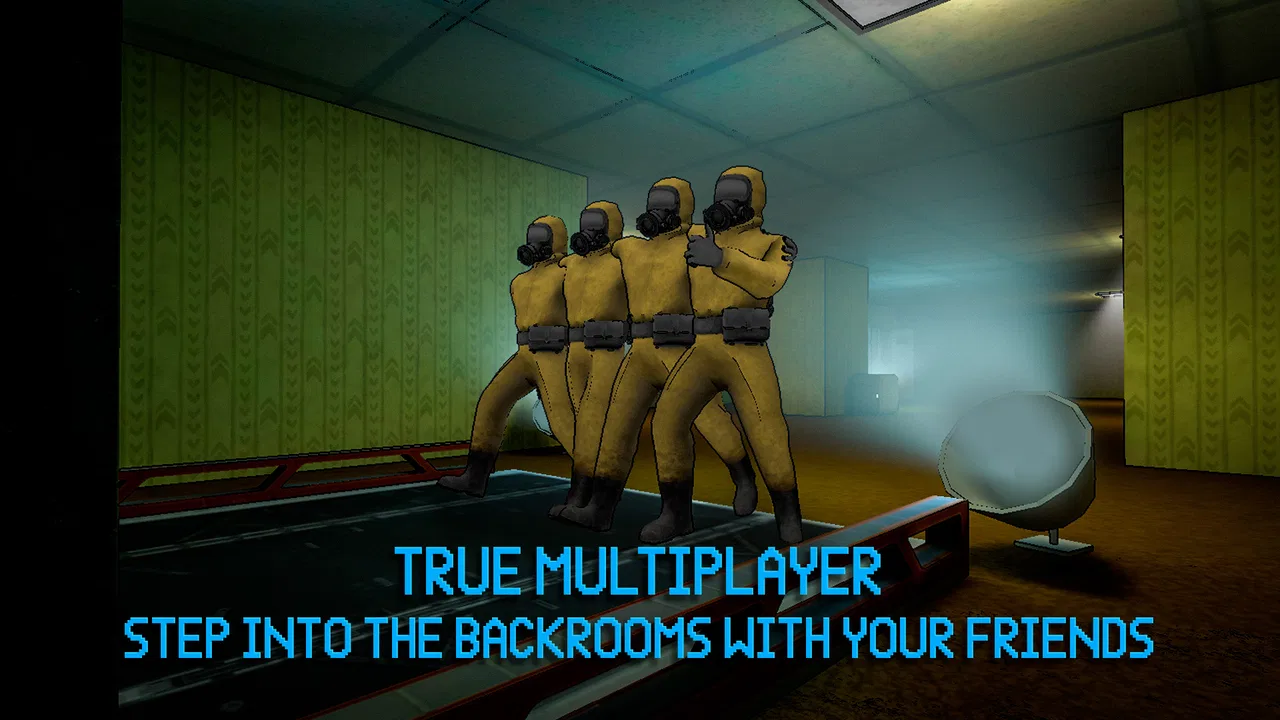
Backrooms Company Multiplayer is the kind of adventure game I open when I want a quick scare with other people rather than a carefully scripted solo horror story. Its central appeal is simple: enter unsettling Backrooms spaces, try to survive what is waiting there, and rely on multiplayer cooperation when the situation becomes confusing. That setup gives the game a social edge that many horror alternatives lack, because a strange sound or sudden threat becomes a shared problem instead of something I face alone.
Developed by Sushi Studios, the game is free to download and aimed at Teen players. It has reached more than a million installs and holds a 4.7 average from roughly nineteen thousand ratings, which suggests that its accessible multiplayer horror formula has found a sizeable audience. I would not treat those figures as a guarantee that every session will be perfect, but they do make it easier to find people who already understand the basic appeal.
How the first sessions establish the goal
The early objective is not complicated, and that is one of the game’s strengths. I am not asked to learn a dense set of systems before the tension begins. The immediate task is to move through the Backrooms, stay alert, and work with the group long enough to survive. That clarity matters on a phone, where a game often has to communicate its purpose quickly before the player loses patience.
You May Also Like

 Blood Strike: 2.5 Anniversary
Blood Strike’s Loadouts Turn Every Drop Into a Tactical Gamble
A close look at Blood Strike’s custom loadouts: how fast access to signature weapons reshapes its battle royale rhythm, rewards preparation, and narrows the gap between fights.

 Pandora - Music & Podcasts
Pandora’s Music Is Easy to Start, but Harder to Recover
Pandora’s strength is its low-effort path from a seed to a station. Its weak spot is how much confidence it asks you to place in connection, setup, and quiet recovery.

 8 Ball Pool
 Is Built on Rivalries, Rematches, and Routine
A close look at the rivalries, rematches, shared routines, and unanswered safety questions that turn a quick pool match into a persistent mobile community.

 Samsung Music
’s Quiet Strength Is Playing What You Already Own
Its reach comes less from spectacle than from dependable access to a personal library. That simplicity is both the app’s strongest retention engine and its ceiling.

 AccuWeather: Weather Radar
AccuWeather Review: A Quick, Clear Forecast for Everyday Decisions
For everyday plans, the best forecast is the one you can understand quickly. AccuWeather makes rain timing, radar, and local conditions easy to act on, with a few trade-offs.

 Hill Climb Racing
Why Hill Climb Racing Still Turns Crashes Into One More Run
A tiny car, a bumpy hill and one more upgrade: Hill Climb Racing keeps resurfacing because its simple chaos makes every near-miss feel personal.
More From Our News Desk
View All News


What makes the opening more interesting than a simple chase game is the uncertainty. The spaces are designed to feel wrong, and the lack of comfort becomes part of the challenge. I find myself paying attention to routes, sounds, and the behavior of the people I am playing with. Even when the next objective seems obvious, reaching it can feel risky because the environment encourages hesitation.
Playing with friends changes the first few rounds considerably. One person may move ahead while another hangs back, but separating too much can turn a manageable situation into panic. That creates an early lesson that the game does not need to explain with a long tutorial: communication is useful, but reckless confidence can be costly. If you are introducing it to a group, I recommend agreeing on a simple callout style before starting. Short messages such as “wait,” “follow me,” or “turn back” are more useful during a scare than a stream of excited commentary.
The multiplayer focus also answers an important practical question: who is this for? I think it suits players who enjoy shared tension, unpredictable reactions, and the comedy that often appears when a group gets frightened. It is less suitable for someone looking for a quiet, atmospheric horror experience with full control over the pace. The presence of other players can make the game more entertaining, but it can also interrupt the mood if the group treats every moment as a joke.
Progress that comes from learning the space
A notable part of the progression comes from becoming more capable as a player, rather than simply expecting the game to hand over constant rewards. On an early attempt, I may waste time reacting to every unsettling detail. After a few sessions, I start recognizing when the group is losing its direction, when it is better to slow down, and when rushing is likely to create a worse problem. Those are modest improvements, but they make later attempts feel more deliberate.
This kind of progress is easy to overlook because it is not always presented as a dramatic achievement. The useful signal is the change in my behavior: I communicate sooner, watch the team’s position more carefully, and stop assuming that the safest-looking path is actually safe. For a horror game, that is a good fit. The satisfaction comes from understanding how to respond under pressure instead of becoming so powerful that the danger stops mattering.
The most valuable unlock is often better group discipline. That may sound less exciting than a conventional upgrade, but it is exactly what gives the multiplayer format staying power. A team that learns to move together and make decisions quickly can turn a chaotic run into a controlled one. The trade-off is that players who expect a clear stream of permanent rewards may find the progression less immediately visible than in action games built around equipment, levels, or collectible upgrades.
For an everyday example, imagine playing after dinner with three friends who have different experience levels. The new player may want to explore every corridor, while the experienced player is already worried about the team becoming scattered. The best session is not necessarily the one where everybody moves fastest. It is the one where the group agrees on a pace, shares information, and treats a retreat as a sensible decision rather than a failure. That social learning is where the game’s replay value becomes most apparent.
Challenge and pacing during a run
The challenge works best when the game gives me enough time to become uneasy before demanding a reaction. Backrooms horror depends on anticipation, and the multiplayer structure adds another layer because I am also watching how others respond. A sudden threat is more effective when the group has just started to feel comfortable. The pacing therefore comes from alternating movement, uncertainty, and moments of pressure rather than from nonstop action.
That rhythm will not suit everyone. Players who want an immediately intense experience may find the slower stretches too restrained, while players who prefer a highly predictable horror campaign may dislike the way social decisions affect the mood. I see the unevenness as part of the identity, but it can still create friction when a session loses momentum or when the group spends too long debating what to do next.
My practical advice is to avoid treating every run as a test of speed. The game rewards attention more than frantic movement. Stay close enough that information can be shared, but do not let one confident player make every decision without discussion. If the team is repeatedly failing because someone keeps splitting off, changing that habit is likely to help more than simply starting another attempt with the same plan.
The Teen content rating is also worth considering before installing it for a younger player. Horror intensity is personal, and multiplayer reactions can make frightening moments feel stronger than they would in a solo game. I would recommend it to teenagers and adults who are comfortable with suspense and cooperative scares, but I would not present it as a gentle introduction to the genre.
What keeps players returning
Backrooms Company Multiplayer creates retention through the appeal of another attempt. A failed run can leave me thinking that the outcome was avoidable: perhaps the group moved too quickly, ignored a warning, or failed to stay together. That feeling is important because it turns defeat into a question. Could we do better if we communicated earlier? Would a calmer route work? Can the least experienced player be given clearer guidance?
There is also a social reason to return. Horror games often become memorable because of the reactions they produce, and multiplayer gives those reactions a second life after the session ends. A mistake becomes a story, and a narrow escape becomes a reason to invite the same people back. This is stronger than playing alone if your friends are available and willing to participate.
At the same time, the game can create retention pressure that is not ideal for every player. Repeating attempts after a failure is enjoyable when the group is learning, but tiring when the same confusion keeps happening. The free entry point makes it easy to try, yet the presence of in-app purchases ranging from ninety-nine cents to eighty-nine dollars and ninety-nine cents per item means players should decide in advance how they want to approach spending. I would begin without buying anything and first judge whether the core multiplayer loop fits my group.
That recommendation is especially useful for players who are sensitive to pressure in free-to-play games. A free download lowers the barrier to entry, but it does not automatically mean the experience will feel equally comfortable for every spending style. I prefer to see whether the game remains enjoyable through ordinary play before considering optional purchases. If the social scares are already carrying the session, there is less reason to rush into spending.
How it compares with familiar horror choices
Compared with a traditional single-player horror adventure, this game gives up some control over atmosphere in exchange for shared unpredictability. A solo title can carefully arrange silence, timing, and story revelations. Here, another player may ruin a quiet moment by running ahead, or may make it better by reacting in a way I did not expect. The result is less polished as a private cinematic experience, but more alive when the group is engaged.
Compared with a standard action game, the emphasis is also different. The goal is not simply to overpower everything in the way. The Backrooms setting works because uncertainty remains important, and the multiplayer format makes decision-making part of the entertainment. If you want constant combat, clearly marked objectives, or a strong character-building system, a different adventure game may be a better match.
It also differs from casual party games. The shared format can produce laughter, but the Teen rating and horror setting mean that the game is not just a relaxed social activity. I would choose it for a group that wants tension with its conversation, not for people who want something everyone can play while barely paying attention.
Device fit, version, and practical expectations
The game supports devices running Android 8.0 or later, which gives it a broad compatibility range for Android players. The current version is 1.52, so I would make sure the app is updated before judging the experience, especially when playing with friends. Multiplayer games are more enjoyable when everyone is using the same current release and understands the basic controls before entering a serious attempt.
Because this is a multiplayer horror game, the quality of the session depends on more than the game itself. Your group’s communication, patience, and willingness to learn all matter. A player who dislikes repeating a route after a mistake may become frustrated, while a player who enjoys experimenting with friends may see the same repetition as the main attraction.
I would also avoid starting with a large, disorganized group if you are trying to understand the game. A smaller team makes it easier to notice how movement, information sharing, and hesitation affect survival. Once those habits are clear, a louder group can be fun, but the extra noise may hide useful clues and make coordination harder.
My verdict on its long-term progression
Backrooms Company Multiplayer sustains play less through a clearly explained ladder of rewards and more through mastery, shared mistakes, and the desire to survive the next attempt. That approach fits the horror setting: if the player becomes completely comfortable, the tension disappears. The strongest progression signal is therefore not just what the game gives me, but how much better the group becomes at reading situations and staying composed.
That design is a good reason to try it, but also the clearest reason to skip it. I recommend it to players who want a free adventure game built around cooperative fear, especially if they have friends ready to communicate and replay failed runs. I would look elsewhere if I wanted a story-first solo campaign, a deep upgrade tree, or a consistently fast pace.
Sushi Studios has made a focused multiplayer horror experience rather than an all-purpose adventure game. Its 4.7 average and audience of over a million installs show that the concept connects with many players, while the Teen rating makes its intended mood clear. After spending time with it, I see the best value in the moments when a group gradually learns to handle the Backrooms together. If you enjoy turning confusion, fear, and teamwork into memorable sessions, this free game is worth trying before deciding whether its optional purchases or repeated attempts belong in your routine.
FAQs for Backrooms Company Multiplayer
01What is Backrooms Company Multiplayer about?
Backrooms Company Multiplayer is a thrilling survival horror game where players navigate an endless maze of unsettling rooms. Inspired by the urban legend of the Backrooms, this game challenges players to escape while avoiding lurking dangers and solving puzzles. The multiplayer feature adds a cooperative element, enhancing the suspense and strategy.
02How does multiplayer work in Backrooms Company Multiplayer?
In Backrooms Company Multiplayer, you can team up with friends or random players to explore the eerie labyrinth together. Cooperation is key, as you must communicate to avoid traps and share resources. The multiplayer element significantly enhances the gameplay experience, making it both challenging and engaging for players.
03Are there in-app purchases available in Backrooms Company Multiplayer?
Yes, Backrooms Company Multiplayer offers in-app purchases. These might include cosmetic upgrades, additional resources, or unique items that can enhance your gameplay experience. While the game can be enjoyed without them, these purchases can provide advantages or personalization options for players who choose to invest.
04What are the system requirements for Backrooms Company Multiplayer?
Backrooms Company Multiplayer requires a device running Android 6.0 or iOS 11.0 and above. The game demands moderate graphics processing power and a stable internet connection for the multiplayer mode. Ensuring your device has sufficient storage and is updated to the latest OS version will help in smooth gameplay.
05Is there a single-player mode in Backrooms Company Multiplayer?
Yes, Backrooms Company Multiplayer includes a single-player mode for those who prefer a solo experience. This mode allows players to explore the Backrooms at their own pace without the added dynamics of multiplayer interaction, focusing more on personal strategy and survival skills.
Pros
- Engaging multiplayer experience.
- Smooth and intuitive controls.
- Regular updates with new content.
- Immersive sound effects and atmosphere.
- Cross-platform compatibility.
Cons
- Occasional server connectivity issues.
- In-app purchases can be pricey.
- Limited character customization options.
- Some levels feel repetitive.
- Game may lag on older devices.

Backrooms Company Multiplayer
Gallery